

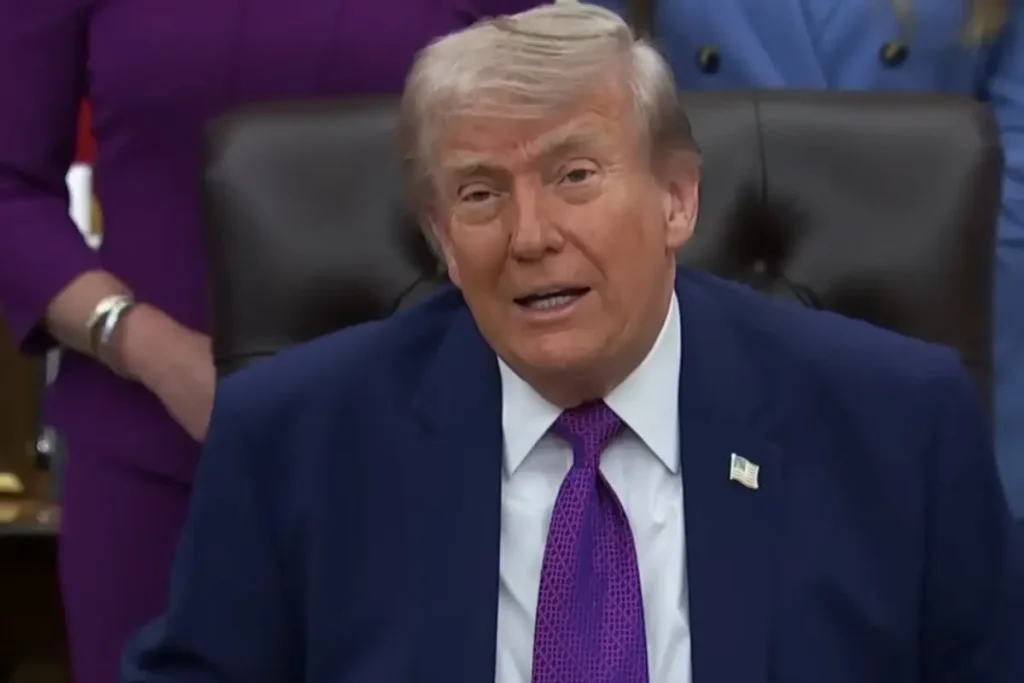
US President Donald Trump stated on Tuesday that the Strait of Hormuz remains open to ships from all nations except Iran. He has decided to replace the proposed 20 percent toll with trade and investment deals that various Gulf nations will undertake with the United States.
In a post on Truth Social, he announced that a total blockade would apply only to ships traveling to or from Iranian ports or carrying Iranian cargo, and he accused the country’s leadership of steering it toward total ruin.
He accused Iran’s leadership of lying and being “violent and malicious.” The US President praised top US military officials, specifically naming Secretary of War Pete Hegseth, Chairman of the Joint Chiefs of Staff Dan Cain, and Commander of US Central Command Admiral Brad Cooper.
Trump said, “Thanks to the tremendous power of the US military, more oil has passed through here than ever before. A special salute to Secretary of War Pete Hegseth, Chairman of the Joint Chiefs of Staff Dan Cain, and Commander of US Central Command Admiral Brad Cooper.
Thanks to them—and all members of the world’s most powerful military—the Strait of Hormuz remains open to all ships except those from Iran. This situation is a result of their [Iran’s] lying, violent, and evil leadership, which is leading them down a path of total destruction.”
He added, “Based on excellent discussions with Middle East leadership, I have decided to replace the 20 percent US reimbursement fee with trade and investment deals that various Gulf nations will execute with the US. These investments will be massive, yet highly beneficial for them and their future.” Trump spoke about the positive impact of new investments in the country and declared that “America is winning again.” He said, “As everyone knows, we have our largest dollar investment in the US compared to any other country in history, but these new investments will make that figure even larger. We will see factories, plants, and equipment arriving in the US at historic levels.
This will create hundreds of thousands of high-paying American jobs! America is winning again—winning like never before. The days of Iran killing hundreds of thousands of people—including 52,000 protesters—are over, and most importantly, Iran will never possess a nuclear weapon!”
This came a day after Trump withdrew his plan to impose a 20 percent toll. On Monday, Trump had stated that Gulf nations should pay the US to secure maritime traffic through the Strait of Hormuz, adding that recent US military interventions had severely weakened Iran’s military capabilities.
Speaking to reporters in the Oval Office, Trump said that Washington should receive financial compensation for securing one of the world’s most strategically vital maritime corridors. Later, in an interview with Newsmax, the US President remarked that American strikes had significantly degraded Iran’s military strength, stating, “Much of their power has been stripped away.” He noted that a large portion of Tehran’s naval and air assets had been destroyed.
Trump said, “They have some things left, but much of it has been taken away. For instance, their military had 159 ships; 159 ships are now at the bottom of the sea.” In a post on his social media handle on Monday, Trump announced that the US was reimposing sanctions on Iran and stated that the US would charge a 20 percent fee to provide security for the Strait of Hormuz, a strategic gateway.
Trump assured that despite rising regional tensions, international maritime traffic through vital shipping lanes would not be cut off from the rest of the world. Trump stated, “Hormuz is open and will remain open, with or without Iran.”
He wrote, “We are reimplementing the ‘Iranian Blockade’—so named because it restricts only Iranian ships or customers from entering or exiting. All other nations will have the opportunity to use the Strait freely and legitimately.”
Attacks involving Iran and the US have sparked fresh tensions in West Asia, impacting the prospects of an interim peace agreement between the two nations. The conflict, which began on February 28, pits Iran against the US and Israel, and has affected maritime transit and energy supply chains.